Great Blue Heron Identification: Size, Plumage, and Field Marks
The Great Blue Heron is one of the easiest large birds to identify in North America — as the Cornell Lab of Ornithology puts it, there is "no other similar species in range."1 It is the largest of the North American herons, built on long legs, a sinuous neck, and a thick, daggerlike bill, with head, chest, and wing plumes that give adults a shaggy appearance.2 In flight it curls its neck into a tight "S" shape, its broad, rounded wings beat slowly, and its legs trail well beyond the tail.2
Measurements
| Measurement | Range (both sexes) |
|---|---|
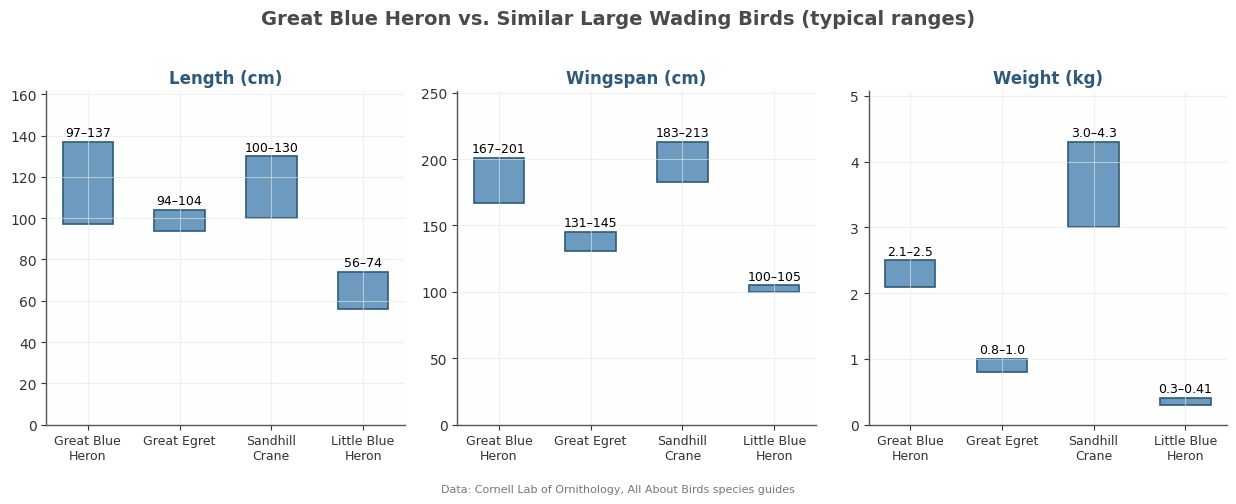
| Length | 38.2–53.9 in (97–137 cm) |
| Weight | 74.1–88.2 oz (2,100–2,500 g) |
| Wingspan | 65.8–79.1 in (167–201 cm) |
| Standing height | Up to ~4–4.5 ft (115–138 cm)3 |
| Bill | Long, straight, ~5–6 in4 |
Figures from the Cornell Lab's All About Birds guide.2 Regional studies add nuance: in British Columbia, adult males averaged 2.48 kg and females 2.11 kg; Nova Scotia/New England adults of both sexes averaged 2.23 kg; Oregon birds averaged 2.09 kg. The all-white "great white heron" population of south Florida is the heaviest, with males averaging 3.02 kg.5 Despite the imposing frame, hollow bones keep the bird light enough to fly high and efficiently.6
Plumage and color pattern
Adults are predominantly blue-gray above, with a mostly white head crossed by a wide black stripe that runs from above the eye to the back of the head, ending in short black plumes. The foreneck is white streaked with black; the shoulders show a black-and-chestnut pattern; and the bill is yellow to yellow-orange (dark above, yellow below).13 During the breeding season the colors intensify — the bill and lores brighten, and adults grow long, showy occipital plumes and shaggy neck and chest plumes used in courtship displays.7 Males and females look nearly identical, though males average larger with slightly longer ornamental plumes.8
Telling age and sex
- Juveniles are duller and more uniformly gray than adults, with a solid dark crown (no white face framed by black), streaked necks, and no long head plumes.910
- Young birds acquire white streaking on the crown by their second fall and approach full adult plumage around their third year; they do not breed until at least two years old.811
- Male vs. female is best judged by size when a pair stands together: females average noticeably smaller with smaller bills; plumage differences are minimal.8
Flight silhouette — the giveaway
Few sights are as diagnostic: broad, rounded wings with a two-toned look (paler leading edge, darker flight feathers), deep slow wingbeats, neck pulled back into a compact "S" with the head resting above the shoulders, and long legs streaming behind the tail.26 The tucked neck instantly separates herons from cranes, which fly with necks outstretched.12 Cruising speed is roughly 20–30 mph, and GPS-tracked birds in Maine averaged about 24 mph in everyday flight.613
-
https://ebird.org/species/grbher3 — eBird: Great Blue Heron species page ↩↩
-
https://www.allaboutbirds.org/guide/Great_Blue_Heron/id — Cornell Lab of Ornithology: Great Blue Heron Identification ↩↩↩↩
-
https://www.coravesbirdingtours.com/great-blue-heron-grand-heron-ardea-herodias/ — Great Blue Heron species account (description and measurements) ↩↩
-
https://www.sfnature.org/uploads/1/3/4/9/134999761/coolfacts.pdf — San Francisco Nature Education: Cool Facts about the Great Blue Heron ↩
-
https://en.wikipedia.org/wiki/Great_blue_heron — Wikipedia: Great blue heron (regional weight data) ↩
-
https://www.sonoranresorts.mx/some-facts-you-may-not-know-about-the-great-blue-heron/ — Facts you may not know about the Great Blue Heron ↩↩↩
-
https://wildadirondacks.org/adirondack-birds-great-blue-heron-ardea-herodias.html — Birds of the Adirondacks: Great Blue Heron ↩
-
https://www.birdfact.com/articles/female-great-blue-herons — BirdFact: Female Great Blue Herons (male vs. female) ↩↩↩
-
https://birdsconnectsea.org/learn/birds-of-wa/bird-facts/great-blue-heron/ — Birds Connect Seattle: Great Blue Heron ↩
-
https://docellensjourney.com/2025/08/11/young-great-heron-or-mature-great-blue-heron/ — Young or mature Great Blue Heron? (head pattern aging) ↩
-
https://www.massaudubon.org/nature-wildlife/birds/great-blue-herons — Mass Audubon: Great Blue Heron life cycle ↩
-
https://blog.nwf.org/2011/03/is-this-a-heron-egret-or-crane/ — National Wildlife Federation: Is this a heron, egret, or crane? ↩
-
http://www.maine.gov/ifw/blogs/maine-heron-observation-network/harpers-marvelous-migration-sparks-more-questions-here-are-some — Maine IF&W: GPS-tracked heron flight data ↩