Do Great Blue Herons Migrate? The Story of a Partial Migrant
Yes and no — the Great Blue Heron is a classic partial migrant. Populations in Florida, along the Pacific coast from Washington to Alaska, and in the Galápagos stay put year-round, while birds breeding east of the Rockies in Canada and the northern United States move south as waters freeze.12 Cornell's range guidance summarizes it simply: herons "generally move away from the northern edge of their breeding range in winter, with some flying as far south as the Caribbean."3
The rules of movement
- What triggers migration: food, not temperature. Herons tolerate real cold, but they cannot hunt through ice. Once lakes, marshes, and snow-covered fields lock up, the birds leave; where open water persists, they may stay all winter even in the north.1
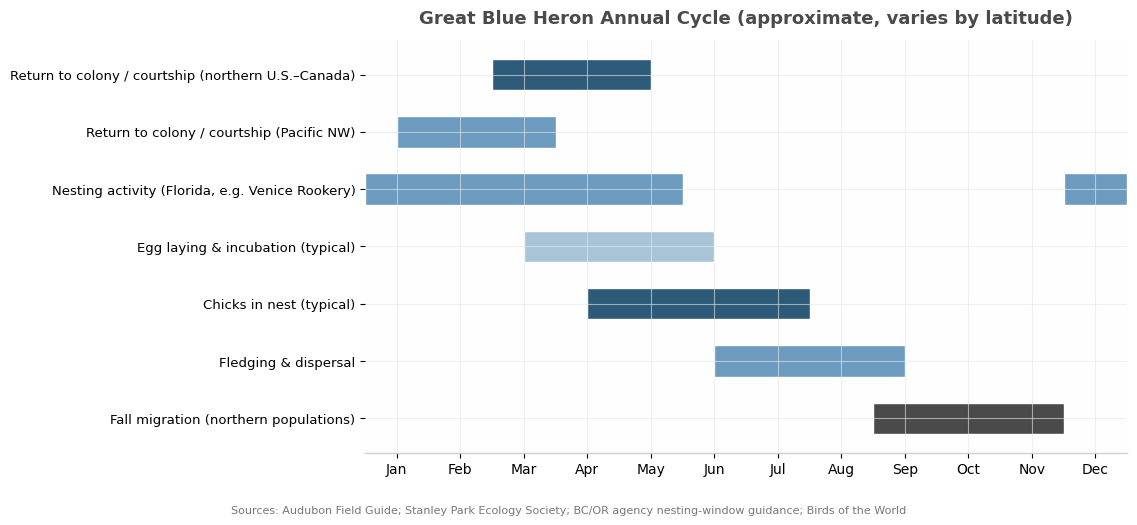
- Fall timing: generally mid-September to late October, later (November–December) in Alberta and Ontario.1
- Spring timing: returns run February through April, earliest in the Midwest and South; central and coastal Canadian breeders may not return until mid-May.1
- How far: from a few hundred miles to more than 3,000 miles, with some birds wintering in Guatemala, the Caribbean, or northern South America.1
- How they travel: alone or in small groups of about 3–12 (occasionally ~100), by day and by night.1
Harper's marathon: what GPS tracking revealed
In 2019, Maine biologists GPS-tagged an adult female heron named "Harper" in Harpswell. After summering on Québec's Chaleur Bay, she departed on October 3 and rewrote expectations: a nonstop, 1,424-mile (2,291 km) open-ocean flight from Saint John, New Brunswick to Nocatee, Florida in 38.6 hours, averaging 38 mph (max 67 mph) at an average altitude of about 607 ft (max 3,103 ft). She then island-hopped the Bahamas and settled in Cuba, completing a 2,488-mile journey in eight days. Accelerometer data confirmed she was flapping/flying the entire ocean crossing — not riding a ship.4
Harper wasn't typical in route but her numbers fit a broader dataset: five GPS-tagged Maine herons averaged 24 mph in routine flight (range 9–60 mph) and typically flew around 164 ft above ground.4 Tracking also explains winter loyalty: a North Carolina male called "Big Blue" nested and wintered within the same 13 square miles of Lake Norman for six consecutive years — proof that where ice-free foraging exists, migration simply isn't necessary.4
Western exceptionalism
West of the Rockies, even birds from the Alaska coastline generally do not migrate. Utah's Bear River Migratory Bird Refuge hosts herons all winter; some individuals there have learned to pirate or scavenge fish caught by Common Goldeneyes in tiny pockets of open water — a behavioral workaround for frozen wetlands.5 Pacific fannini herons in British Columbia shift seasonally between intertidal foraging and winter grassland rodent hunting rather than migrating.6
Migration fast facts
| Question | Answer |
|---|---|
| Do all Great Blue Herons migrate? | No — only northern/eastern populations; it's a partial migrant1 |
| Longest documented nonstop flight | 1,424 mi over open ocean, 38.6 hrs ("Harper," 2019)4 |
| Typical migration speed | Avg 38 mph on marathon legs; ~24 mph routine4 |
| Flock size on migration | Usually solo or 3–12 birds1 |
| Winter destinations | Southern U.S., Mexico, Central America, Caribbean, N. South America13 |
| Year-round regions | Florida, Gulf & Pacific coasts (incl. S. Alaska), Galápagos1 |
-
https://www.birdfact.com/articles/do-great-blue-herons-migrate — BirdFact: Do Great Blue Herons migrate? ↩↩↩↩↩↩↩↩↩↩
-
https://bearriverblogger.com/great-blue-herons-and-winter/ — Bear River Blogger: Great Blue Herons and winter ↩
-
https://www.allaboutbirds.org/guide/Great_Blue_Heron/maps-range — Cornell Lab of Ornithology: Range map ↩↩
-
http://www.maine.gov/ifw/blogs/maine-heron-observation-network/harpers-marvelous-migration-sparks-more-questions-here-are-some — Maine IF&W: Harper's Marvelous Migration ↩↩↩↩↩
-
https://bearriverblogger.com/great-blue-herons-and-winter/ — Bear River Blogger: goldeneye scavenging behavior ↩
-
https://stanleyparkecology.ca/wp-content/uploads/2021/07/Heron-FAQ-for-website_branded.pdf — Stanley Park Ecology Society: Great Blue Heron FAQ ↩