Great Blue Heron Conservation Status: Secure Overall, Struggling Locally
Global and continental status
The Great Blue Heron is rated Least Concern on the IUCN Red List, with a population trend assessed as increasing (last assessed August 2020).1 Partners in Flight estimates a global breeding population of about 700,000 and assigns a Continental Concern Score of 8 out of 20 — a species of low conservation concern.2 The North American Breeding Bird Survey recorded stable-to-increasing numbers in the U.S. between 1966 and 2019.2 NatureServe ranks the species G5 (globally secure).3 Climate projections are also benign: Audubon's Survival by Degrees analysis rates the species "Stable," projecting roughly 36% range gained and 0% lost at +1.5 °C of warming.4
By continental standards, this is a conservation success: a bird once shot for plumes and "because it made a conspicuous target" is now protected, abundant, and expanding into created wetlands like reservoirs and beaver ponds.56
The local exceptions — read this before celebrating
Aggregates hide regional crises that matter for any conservation-minded coverage:
| Region | Status | Key data |
|---|---|---|
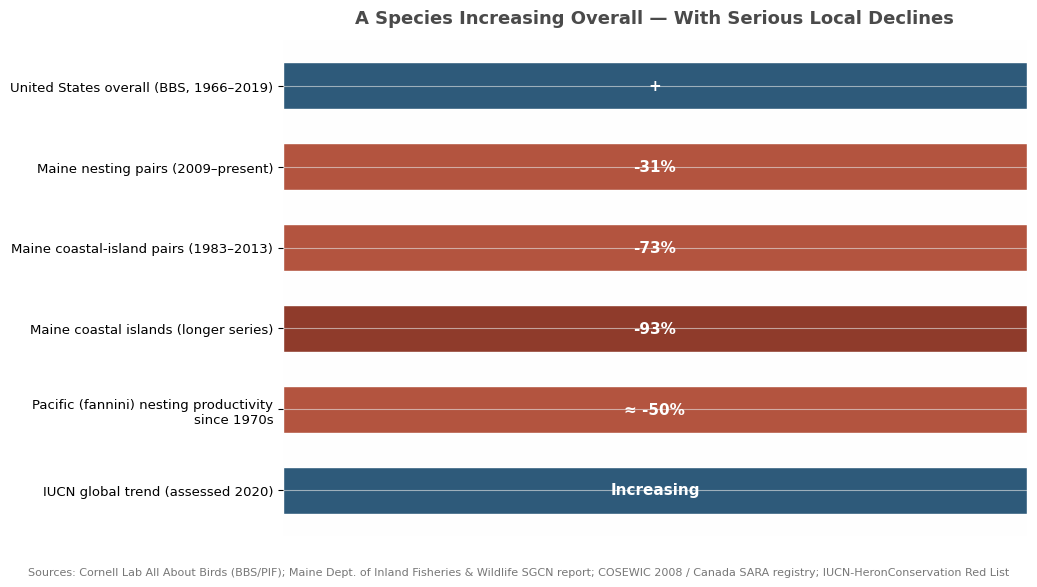
| Maine | State Special Concern; Priority 2 SGCN | 31% statewide decline in nesting pairs since 2009; coastal-island pairs down 73% (1983–2013) and 93% over the longer series; BBS −2.8%/yr 1983–20187 |
| Pacific coast (fannini) | Canada: Special Concern (COSEWIC 2008) | Only 4,000–5,000 nesting adults; nesting productivity down perhaps 50% since the 1970s; ~80% of Canadian birds nest in the two most developed regions8 |
| Interior BC (herodias) | S3? (imperiled, uncertain) | Small, scattered colonies; eagle predation and development ongoing9 |
| South Florida (occidentalis, "great white heron") | BirdLife International: Endangered (as a separate species, 2020) | Declines linked in part to elevated mercury in waterways; assortative mating limits recovery through interbreeding1210 |
| United States overall | Secure | BBS increasing, 1966–20192 |
Legal protection
Great Blue Herons are protected under the Migratory Bird Treaty Act of 1918 (and Canada's Migratory Birds Convention Act), making it illegal to capture, harm, or possess the birds, their nests, or their eggs.5 Many states and provinces add layers: Oregon's Forest Practices Act prohibits forest operations within a quarter-mile of active nest trees from February 15 to July 31, and British Columbia protects nests year-round under its Wildlife Act.1112
How herons are monitored
- Breeding Bird Survey & Christmas Bird Count — continental trend data.2
- Colony surveys — aerial and ground nest counts; e.g., North Carolina's 2012 survey (7,680 nests, 518 colonies), Stanley Park's annual census, and volunteer programs like Venice Rookery Watch (records since 1997, feeding Florida FWC).61314
- GPS/satellite telemetry — projects like Maine's Heron Observation Network tagged birds ("Harper") to map movements and habitat use.15
- Contaminant monitoring — egg collection programs on the St. Lawrence and in BC track mercury, PCBs, DDE, and PBDEs as ecosystem sentinels.16
- Community science — eBird and local heronry registries feed distribution and phenology data.2
The bottom line for communicators
Say both things: the Great Blue Heron is not an endangered species and is thriving across most of North America — and several regional populations (coastal Maine, the Pacific coast subspecies, the Florida white form) are in documented decline and receive active legal protection and management. The species' future depends less on total numbers than on safeguarding colony sites, wetland foraging habitat, and water quality.
-
https://heronconservation.org/conservation/red-list/ — HeronConservation: Heron Red List (IUCN categories) ↩↩
-
https://www.allaboutbirds.org/guide/Great_Blue_Heron/lifehistory — Cornell Lab of Ornithology: Conservation ↩↩↩↩↩↩
-
https://explorer.natureserve.org/Taxon/ELEMENT_GLOBAL.2.100203/Ardea_herodias — NatureServe Explorer: Ardea herodias ↩
-
https://www.audubon.org/field-guide/bird/great-blue-heron — Audubon Field Guide: climate vulnerability ↩
-
https://www.massaudubon.org/nature-wildlife/birds/great-blue-herons — Mass Audubon: Great Blue Herons ↩↩
-
https://www.ncwildlife.gov/media/1885/open — NC Wildlife Resources Commission profile ↩↩
-
https://www.maine.gov/ifw/wildlife/reports/pdfs/SGCN_Reports/SGCN/Great%20Blue%20Heron__Ardea%20herodias.pdf — Maine IF&W: Great Blue Heron SGCN report ↩
-
https://www.canada.ca/en/environment-climate-change/services/species-risk-public-registry/management-plans/great-blue-heron-fannini-2016-proposed.html — Government of Canada: fannini Management Plan ↩
-
https://a100.gov.bc.ca/pub/eswp/esr.do?id=17626 — BC Conservation Status Report: herodias subspecies ↩
-
https://heronconservation.org/jhbc/vol07/art01/ — Journal of Heron Biology and Conservation: Great White Heron taxonomy ↩
-
https://oregonforests.org/sites/default/files/2018-04/WIMF_data_Great_Blue_Heron.pdf — Oregon Forests: Great Blue Herons and Forestry ↩
-
https://www2.gov.bc.ca/assets/gov/environment/natural-resource-policy-legislation/legislation-regulation/frpa-pac/wildlife-habitat-features/whf_field_guide_kootenay_boundary_grblueheron.pdf — BC Wildlife Habitat Features Field Guide ↩
-
https://stanleyparkecology.ca/wp-content/uploads/2021/07/Heron-FAQ-for-website_branded.pdf — Stanley Park Ecology Society: colony counts ↩
-
https://veniceaudubon.org/conservation/rookery-watch — Venice Audubon: Rookery Watch ↩
-
http://www.maine.gov/ifw/blogs/maine-heron-observation-network/harpers-marvelous-migration-sparks-more-questions-here-are-some — Maine IF&W: GPS tracking ↩
-
https://www.planstlaurent.qc.ca/en/state-monitoring/monitoring-sheets/great-blue-heron-2015 — State of the St. Lawrence: Great Blue Heron sentinel species ↩