Great Blue Heron Breeding: Courtship, Rookeries, and Nest Building
Great Blue Herons breed in colonies called heronries or rookeries — gatherings that range from a handful of nests to 500 or more, averaging around 160 nests per colony.12 Colonies are usually single-species, though herons sometimes nest alongside egrets, anhingas, or other waders, and they are sited where predators and people can't easily intrude: wooded swamps, islands, beaver flowages, or treetops 100+ feet up.23
The breeding calendar
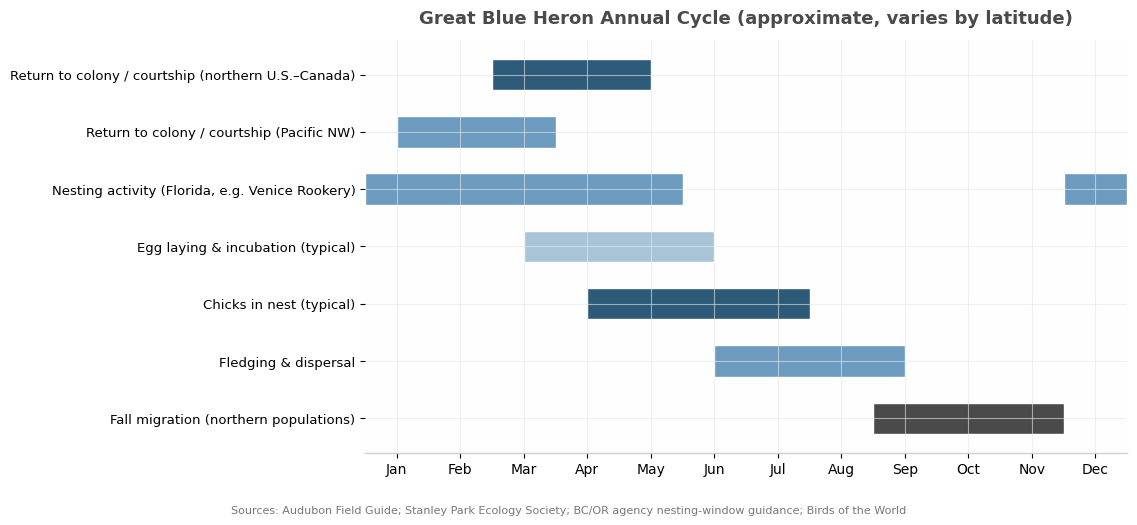
Timing shifts with latitude. In Florida and coastal British Columbia, birds may return to colonies as early as mid-January; mid-February to mid-March is typical for the Pacific Northwest; northern populations arrive March–May.45 Males return first, claiming nest sites a week or so before females arrive.4 Egg-laying generally runs February–May (later in the north), and in BC the roughly four-month nesting season leaves room for re-nesting if a first attempt fails — pairs can lay up to two replacement clutches, with eggs possible as late as May or June.46
Courtship: plumes, sticks, and sky-pointing
Courtship is among the most elaborate of any North American bird. The male selects a nest site and advertises from it: stretching his neck up with bill pointed skyward (the "stretch" display), flying in circles above the colony with neck extended, erecting his head and neck plumes, shaking twigs held in his bill, and snapping his bill shut.78 A receptive female approaches, and the pair seals the bond with greeting ceremonies — twining necks, clattering bills together, raising their nuptial plumes.9 Pairs are monogamous for the season but typically choose new mates each year.9
Division of labor
| Task | Who does it |
|---|---|
| Choose nest site | Male7 |
| Gather sticks & material | Mostly male (from ground, shrubs, or unguarded nests)10 |
| Build/weave the nest | Mostly female, from material the male delivers10 |
| Incubate eggs | Both — typically male by day, female by night4 |
| Feed chicks | Both, by regurgitation7 |
The nest itself
A new nest is a rough platform of sticks about 20 inches (50 cm) across, built in anywhere from 3 days to 2 weeks and lined with pine needles, moss, reeds, dry grass, or mangrove leaves.10 Nests are reused and enlarged for years: veteran structures can exceed 4 feet (1.2 m) across and nearly 3.5 feet (0.9 m) deep.10 Studies find herons return to colonies more faithfully than to specific nests — a bird often takes over any available nest, though it tends to prefer one in the same tree species as its original.11
Where colonies form
Ideal sites combine nearby food (usually within 2–4 miles, up to ~10) with isolation: islands, trees standing in water, or tall timber.212 When trees are unavailable, herons improvise — sagebrush, cacti, channel markers, beaver mounds, duck blinds, and artificial platforms all host nests.2 Urban colonies are increasingly common: Stanley Park's colony in Vancouver (documented since 1921, at its current site since 2001) held 116 nests in 2014, and Seattle's largest colony nests beside the Ballard Locks amid trains, loudspeakers, and barking sea lions.413
Colony etiquette for observers
Early-season disturbance is the biggest human threat: keep at least 100 m of distance from active colonies, watch with optics, and avoid loud noise — abandonment risk is highest before eggs hatch.314
-
https://www.ncwildlife.gov/media/1885/open — NC Wildlife Resources Commission: Great Blue Heron (colony sizes) ↩
-
https://en.wikipedia.org/wiki/Great_blue_heron — Wikipedia: Breeding ↩↩↩↩
-
https://www.allaboutbirds.org/guide/Great_Blue_Heron/lifehistory — Cornell Lab: Nest placement ↩↩
-
https://stanleyparkecology.ca/wp-content/uploads/2021/07/Heron-FAQ-for-website_branded.pdf — Stanley Park Ecology Society: Heron FAQ ↩↩↩↩↩
-
https://www.birdfact.com/articles/great-blue-heron-nesting — BirdFact: nesting timing ↩
-
https://birdsoftheworld.org/bow/species/grbher3/cur/breeding — Birds of the World: Breeding ↩
-
https://www.audubon.org/field-guide/bird/great-blue-heron — Audubon Field Guide: Nesting & displays ↩↩↩
-
https://abcbirds.org/birds/great-blue-heron/ — American Bird Conservancy: Courtship ↩
-
https://www.allaboutbirds.org/guide/Great_Blue_Heron/lifehistory — Cornell Lab: Behavior ↩↩
-
https://www.allaboutbirds.org/guide/Great_Blue_Heron/lifehistory — Cornell Lab: Nest description ↩↩↩↩
-
https://www.birdfact.com/articles/great-blue-heron-nesting — BirdFact: nest reuse ↩
-
https://nrm.dfg.ca.gov/FileHandler.ashx?DocumentID=1571 — California Wildlife Habitat Relationships System ↩
-
https://greenseattle.org/herons-commodore-park/ — Green Seattle Partnership: The Herons of Commodore Park ↩
-
https://oregonforests.org/sites/default/files/2018-04/WIMF_data_Great_Blue_Heron.pdf — Oregon Forests: Great Blue Herons and Forestry ↩